History Revisited


Kashmir has fascinated civilised humans for thousand of years. She has attracted many warriors, kings, poets, sages and scholars but she has been always out of reach of all these men. She is young damsel who is blandishing her eyes and flowing her hairs to encourage the people to rush towards her in their off senses. They take their horses and swords, carriages and wheels, imagination & zeal to have some exchange of glances with her but all of them have fallen on her feet. She is like an arrogant princess laughing on their defeat with one hand on her bosoms another on her beaming cheeks.

Now, fate and destiny have changed for Kashmir. Its body is stained with blood. Its beautiful valleys have been notched off beautiful sceneries and horrifying patches have been put instead. One can’t count its wounds. One can’t think how to heal its uncountable and immensely paining wounds. Even if you can, some scar marks will be left behind.

The history is a mute spectator. It watches each and every minute detail with patience and tolerance. When it speaks out, it utters the slightest details of times and events. It is so bold in telling truth that sometimes it sounds very harsh but it always talks crystal clear. It can never leave any culprit unscathed, it can never forgive anybody. What has been dotted in pages of history will come out. Her praises and applauses are worthy and unbiased, her warnings are firm & unbreakable and her truths are voluminous like volcanoes.

History of humanism

There is a folk story, very famous in Kashmir. It is about a woman whose name was Padmavati in her young age. She was married to a man who was not only ignorant, but cruel too. Her marriage brought the same old story of oppression live and real seen all the nook and corner of her life. She subjected her to cruelty in laws. She left her husband’s home and went to unknown place to search truth. When she came back from her mysterious journey, she had become a mystic and Sufi. She started preaching local villagers through her lyrical verses. She, like Kabir, opposed all the religious bigotries. She taught the lesson of love, kindness, service to humanity. In passage of time, she became Lalleswari for Hindus and Lalla Arifa for Muslims. Till then she had become a venerable character for all the Kashmiris. She is sill living in hymns songs and proverbs of Kashmiri language.

This Sufi woman adopted a son who was born in 1356 A.D. The boy was nurtured and nourished by Lalleswari’s motherly care. He was destined to become Sheikh Nuruddin - another sage to teach lessons of humanity. He too lived in the hearts of Hindus and Muslims. Nuruddin was called Nand Rishi by Hindus and Sheikh by Muslims. His grave is in midst of valley of Kashmir. The place is called Charar-e-Sharief. This dargah attracts large number of Hindus and Muslims who come there to get solace and peace.

The lalleswaris and nand rishis the hazratbals and chrar-e-shariefs are immortal remains of humanism. People do not come here to see whether the curtains are green or saffron, the symbols are made up of moon and stars or sun and trishul. Instead, they come here to weep out their woes. They have some unspeakable demands; they have something to say which they cannot say anywhere else; they have something to show, which they cannot show anywhere else. This is their natural faith, it does not know about doctrines of clergies and diplomacies of monarchs.

When the valley weeps these pilgrimages, soak the tears of this wailing widow.


History of kings, kingdoms and their tiaras

The oldest and most authentic book which describes about Kashmir is Rajtarangini (king of rivers) written by a Pandit scholar, Kalhana. This book was completed in AD 1148. The book has eight parts, capturing the whole history of Kashmir till period of the compilation of the book. This book takes the story back in to the Mahabharata age, as it describes that 27 generations of Pandavas ruled over this state. However, the book relies more on the mythological and religious sources than history. This is why it is difficult for the readers to alienate the history from mythological stories, e.g. there was, it says, huge river called Sat Sari flowing there where at present Kashmir’s sprawling valley is situated. The war between Demons and devtas (trinity of Hindu gods, Brahma, Vishnu and Mahesh) resulted in evolution of valley from beneath the river. The Gods seeing the beauty of the valley decided to reside in the Himalayas. This valley was a property of Rishi Kashyap. On his name, Kashmir was christened as the name of this vale.

The time passed with its own pace and lot of water flowed into Satluj; clans of Indo Aryan families inhabited The Kashmir. We know very poorly about that period of history of Kashmir, but it is evident that Hinduism was the primary religion and philosophy of the land.

Some more timepieces elapsed and there arose a great regent called Ashoka in India. This great Maurayan emperor brought Kashmir into ambit of his empire but he found resistance in Hinduism because Ashoka also tried to superimpose Buddhism. He failed. Two hundred years after the decline of Mauryan Empire, Kanishka, and a Kushan king ruled over from Kshmir to Bengal, brought Buddhism again in the valley. Not only that, Buddhism spread all over central Asia, Afghanistan ,Tibet by A.D. 352, and to China,
Japan and Korea by AD 552 from Kanishka’s Kashmir.

After Kanishka, a Hun ruler, Mihurkula set his empire in Kashmir. This was followed by Karkota dynasty. After that, there was rule of Utpala dynasty that ruled Kashmir from AD 855 to AD 1003. All these years were unhappy for Kashmir. For almost 400 years, Kashmir saw only marauders, killers, debauchery and lust in her own men and women. In short, there was nothing good to be written in history.

The time when Kalhana was writing last pages of his grand book, Rajtarangini, Kashmir was plagued by the incidents of intrigues, double-crossing and conspiracies. Regents were immoral and corrupt; public was thrashed on all quarters; junta was feeble and foolish; this beautiful woman called Kashmir was longing for someone to her fate.

This was the correct time for the rulers from the other sides to look towards Kashmir. First, Sultan of Delhi (at that time Quatabuddin Aibak was at throne in Delhi) tried his luck but his interest was half hearted. One of the most tyrannous and most cruel warriors ever born in history Changez Khan (or Genghiz Khan) made another attempt. He sent his marauders to Kashmir but they never reached Kashmir. Another Mongol conquered Kashmir sixty years after Changez. He was called Kublai Khan the great. His rule was extended from Tibet to modern Laddakh. This north - eastern part of Kashmir still today tastes the same old Mongol wine in its cultural delicacies.

On the same footing, this was also the right time for Sufis and sages to conquer the hearts of Kashmiris. It was the time when Sufi movement had swept all over Indian peninsula. It swept Kashmir too. At last, the sword of love wins the battle. What big staunch Muslim invaders could not do with their daggers and sabres these lean, wandering pantaloons had done. Thus, the advent of Islam happens in Kashmir.

M.J. Akbar in his book “Kashmir behind the Vale” writes-

“a strange and wondrous combinations of events – the arrival of a Musami Syed disciple of Sufi divine Shah Niamatullah Farsi of the Suharwardy order; the presence of an adventurer driven by a dream from his native Swat( now in Pakistan ); the death of great king Kublai Khan in distant Beijing, to name but three – created the conditions of the establishment of first Islam and then Muslim rule in the valley of Kashmir by the fourteenth century.”

Name of the Sufi was Syed Bilal Shah, lovingly called Bulbul Shah by the people of Kashmir. By the time, he died in 1327, the king, his brother and the commander in chief of army were Muslims, and the first mosque of Kashmir had been built in Shrinagar. Today this place where grave of Bulbul Shah and mosque are situated is called Bulbul langar.

M.J.Akbar in his book gives a description of the first Muslim King Shah Mir. It is not only interesting but unbelievable too. He was living in Swat and saw a dream that he will become a monarch one day, so he travelled all along to Kashmir to search his destiny. The trail of events was such that he actually seated on the throne of Shrinagar and remained there till his death. This dynasty ruled Kashmir for 222 years. This was a peaceful and prosperous time for Kashmir as well as its economy and polity. The greatest king of this period was Zainul abedin. People of the valley lovingly called him Bud shah because of his industrious works like popularising Kashmiri shawl.

Mughals ended this rule and Kashmir went to the hands of rulers who were not Kashmiri. On 28th March, 1586, Mughals captured the Kashmir. That day marked the end of Kashmir’s independence.

However, Akbar proved to be a great ruler for Kashmir. After Akbar, Jehangir too cared a lot for Kashmir. Jehangir’s love for Kashmir is evident from the scenic beauty of Shalimar Bagh and Nishat Bagh. He wanted to die there but he could not. After Jehangir, Shahjahan and Aurangzeb kept their mettle in Kashmir.

Yet again, the turbulent situation arose after the death of Aurangzb. In forty-six years after the death of the Mughal king Kashmir saw fifty-seven governors and all of the were pathetic. The religious bigotry, in now Muslim majority Kashmir was a common practise by governors and kings. This was the time when Afghan governors of Ahmad Shah Abdali snatched Kashmir and plundered it. M.J. Akbar in his book cites a couplet –

Puisdan az kharabiye gulshan zi baghban
Afghan kashid guft kiAfghan kharab kard.


(I asked, says the poet, who laid waste this garden. With a deep sigh he replied: “it was the Afghan “)
This couplet tells how much cruel that period was that still lies in the memories of poets and commons.

Afghan ruled Kashmir until, 1819. In 1819, Maharaja Ranjit Singh of Punjab captured Kashmir. But the rule was not very much justified, now the misruling was against the Muslims quite contrary as it was during the rule of the Afghans. The collapse of Kashmir was inevitable; it seemed, after the death of Ranjit Singh in 1839. The crimes and beggary again flourished in Kashmir. Eventually Kashmir never recovered from its catastrophe since 1753.
After Sikh rule, another fierce battle was fought; British defeated Sikhs and captured the big state of Punjab. They sold Kashmir to Gulab Singh Dogra for 75 lakhs rupees. He was a commander in Ranjit Singh’s army but he betrayed his king.

History of political satire

The satire made against the people of Kashmir had begun in 1846. Dogras helped British in Anglo- Sikh war in 1848 and more bravely supported them in 1857 to crush the first mutiny against British. Gulab Singh’s son Ranbir Singh was also loyal to the white masters and cruel for Kashmiris. But British slowly crept into Dogra’s Kashmir. First, an officer on duty (OSC) was sent then a civil court was created in 1872. In 1888, the OSC reciprocated his special position provided by the British by splitting the royal family. The raja was accused in a false case and disposed. Everybody was stunned. Now British have clasped Kashmir that they wanted to protect themselves from Tsarist Russia.

In 1925, Hari Singh became the king of Kashmir. Till then unemployment, illite
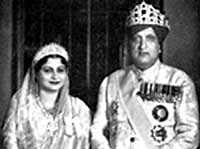
racy, poverty, discrimination against Muslims had become common practices. The public was against the British Raj and Hari Singh both. The total power of administration and law was under the authority of the King, there was no democracy. The British exercised the real power. The Dogras had become real feudal class.
(Dogra monarch, Maharaja Hari Singh with Maharani Tara Devi. )

In this scenario, a political movement started which remained after the independence of Kashmir and India. A party was founded called Muslim conference and its leader was Shaikh Abdullah. He was born in 1905 and was educated in Aligarh. He came and conquered all the hearts of Kashmiris. He made the Party in 1933. This was the incident which changed the fate of this land and continued to be in memories of people constantly at the time of independence and thereafter.


~MILIND


References

M.J. Akbar, Kashmir behind the Vale, VIKING 1991
Encyclopaedia of Britannica, 2000

Poets of the World


William Blake


A poison tree

I was angry with my friend
I told my wrath, my wrath did end
I was angry with my foe
I told it not, my wrath did grow

And I watered it in fears,
Night and morning with my tears,
And I sunned with smiles,
And soft deceitful wiles

And it grow both day and night,
Till it bore an apple bright
And my foe behind it shine,
And he knew that it was mine.

And into my garden stole
When the night had veiled the pole
In the morning glad I see
My foe outstretched beneath the tree.


In this simple but powerful poem, William Blake describes how a feeling of anger, which soon disappears if there is good will and friendship, can become deadly poison, if instead,
there is distrust and enmity. Using the metaphor of a poison tree, the poet creates a vivid picture of how such anger, hidden in the mind, grows daily by feeding on other harmful feelings ; such as fear , until it becomes capable of causing great destruction and wicked sense of pleasure in it.

William Blake was born on November 28, 1757 in London, Great Britain. Today Blake is regarded as one of the earliest and greatest figures of romanticism but in his own age, he was regarded as a mad and the fault of him was that he was a single-minded and unworldly human. He lived in poverty and died in neglect.

Since childhood, Blake developed a sense of mysticism in him. He would describe about his experiences or visions he saw in countryside. In these visions, he would see angels in a tree and sometime he would see prophet Ezekiel in a field. Interesting thing is that Prophet Ezekiel was born in sixth century BC. He was follower of Judaism and was one of them who wrote Old Testament. The prophet is also related to concept of Israel, a Jewish country. It's a distant but not an abnormal intimacy Blake would show towards. All along his life he wrote about ancient mystical world.

Another example from his life, which shows, his mental state, is related to death of his younger brother, Robert. When his father died in 1784 Blake started a printing shop in London, he took his brother Robert too. Robert died in 1787. Blake who has given his care and nursing to his brother was so touched and moved that he would see his brother's vision rising from ground to ceiling more often than once. One day Robert appeared to him and told him about the new methodology of engraving the texts and illustrations. Blake used this method for engravings in his books and called it "illuminated painting".

Most of the Blake’s works were decorated with the above kind of engraving. The first books in which he used the new kind of engravings were, There is no natural religion and All Religions are One published in 1788.

The various kinds of incidents in his life and mystical development of his mind made an unusual impact on his character. His poetry is clear reflection of this fact. Look into this piece of verse, which is one of the most famous poems composed by him; The Tiger. It was part of his book - Songs of experience (1794)

Tiger! Tiger! Burning bright
In the forests of the night,

In these lines, tiger is an imaginary character. It is a mixture of humanity’s lust and cruelty. The poet asks the god, which are you the same creator who has created the lamb and this tiger both. His poem is full of such metaphors that indicate towards divinity and supernatural powers.

In 1793, Blake and his wife went to southern part of London called Lambeth where they lived for seven years. He spent these years in writing some prophetic books. Again, the same spiritual and philosophic ideas were developed and transformed into poetry by him. Blake loved to be there among these divine whisperings. These seven years were best part of his literary life because he wrote a series of majestic books. These are America, A prophecy (1793); Europe, A prophecy (1794); The book of Urizen (1794); The book of Ahania; The book of Los, The song of Los (1795).

These prophetic books are description of an imaginary cosmic fight between conflicting forces - reason (Urizen) and imagination (Los). The Christian and Jewish mythological concepts have been readily used in these books to present picturesque depiction of cosmic forces.

From 1800 to 1803, Blake lived happily in a seaside cottage in Sussex provided by his patron. Soon he felt his patron intolerable, moreover his wife's health deteriorated. Therefore, he came back to London in 1803. Back in London, he wrote three epics, Jerusalem, Milton and Vale. But Blake's life from 1803 to 1820 was too difficult to bear. He had no work. He was not publishing poetry, as there were only few takes of his poetry and engravings.

In 1819, he met a new patron. His name was John Linnell. John introduced to group of young artist where Blake was revered as master. Blake too enjoyed this company. In 1821, John commissioned him to make watercolour paintings. Blake completed this work before his death. Critically these works were acclaimed as Blake’s best art. In 1825, another assignment of 102 paintings on Dante’s Divine Comedy was given to him but he could not complete this work.

The life he got in his last couple of years was one the he longed for whole of his life. He was working even in his 70th year. He died, as he wanted. He had brush in his hand while lying in bed. He died on August 12, 1827. Blake was buried in London where he spent biggest part of his life.


~Sharique

Health Status in Urban Bihar 1

Bihar is the third largest state in terms of total population size, occupies the 11th position, its share in national urban population being 3.04 percent. 2001 census shows that Bihar has an urban population of 8.67 millions comprising 10.47 percent of the state. There has been a decline in urbanisation of Bihar during 1990s. In 1991, undivided Bihar had 13.1percent urban population, which came down to 10.47 percent in 2001. Partly it is attributed to going of big urban centres like Dhanbad, Jamshedpur and Ranchi to Jharkhand after the division of state. However, it is also attributed to the process of liberalization. The migration to urban centres in developed states has been more due to higher flow of financial, industrial and infrastructural investments. However, the backward states have not attracted private capital due to lack of infrastructure. Even the government has not been able to achieve much in terms of industrialization of backward states.

Patna, the capital of Bihar with 41.80 percent urban population is the most urbanised district and has almost one fourth(22.69 percent) of total urban population of the state Patna district with a percentage decadal growth of 43.02 during 1991-2001 has an urban population of 1.96 millions (census 2001)

There are 19 cities in Bihar (having population of 100,000 and above). Of this patna falls into sub-class M5 (population between 1,000,000-1,999,999), Gaya Bhagalpur and Muzaffarpur in sub-class M3(300,000500,000),Darbhanga, Biharsharif and Arrah in sub-class M3(200,000-299,999) and rest 12 cities in sub-class M1(100.000-199,999).

It is observed that the highest incidence of urban poverty is mostly in small cities. NSS survey shows that with the increase in size of town the incidence of poverty declined steadily. The head count ratio of the urban poor in M1 towns in 1987-88 was 47.4 percent and M5 towns were 26.73 percent. Bihar with only one M5 city is dotted heavily with small cities and towns and thus has a large burden of urban poor population. As per the estimates given by the planning commission for 1993-94, thirty-five percent of the urban population in Bihar was below the poverty line. As per TCPO, estimates Bihar had a slum population of about 3.5 millions in 2001. The census of India puts slum population to be little over 0.5 millions only.

Health Issues of Urban Poor

The state urban health infrastructure is in extremely bad shape. Bihar has 6 medical college hospitals, 23 district hospitals out of 38 districts and only 23 sub-divisional hospitals out of 101 subdivisions (RCH II). Bihar does not have a single urban PHC or health post. Only Patna andBhaghalpur have 2 municipal dispensaries in each district according to an estimate. There are less than one dozen family welfare centres in the state. 19 cities of Bihar have 33 urban dispensaries.
More than one-fifth of the females in urban Bihar still have to marry before 19 years of age. Only 23 percent of married women in urban Bihar make decision for obtaining health care of her. The median age at first cohabitation is 16.4 for women living in households with a low standard of living. It reflects that the women are the disadvantaged
[1] lot even in urban households as regards to making decision in terms of either seeking health care for herself or having teenage pregnancy.

Water sources and sanitary facilities have an important influence on the health of household members, especially children. Only 35 percent of the urban population has access to piped drinking water. One third of the urban population has no sanitary facility of latrines/toilets. Crowded conditions also affect health as well as the quality of life. 37 % of the urban households live in houses with three or more persons per room. One-forth households in urban Bihar have low standard of living index (SLI), defined in terms of ownership of household goods like durable goods and type of kitchenware used.

In reference with the scenario of health status in Bihar, briefly described above, a survey was undertaken in various cities of Bihar. Major conclusions are given here –


Preference for facilities for seeking Health Services

  • Urban poor do not have confidence in Govt. hospitals when it comes to curative services.
    Only 1/10th of respondents visited the OPD( outpatient departments) for treatment of children in case of diarrhoea and of women in case of RTIs
  • (Reproductive Tract Infections).
  • Neighbourhood chemist shops are major provider of curative services to urban poor ( 28% in case of Diarrhoea an 29% in case of RTI ). Every 3 out of 10 urban poor are opting a chemist shop for seeking treatment.
  • Urban Poor’s confidence in promotional health services offered by Government health services providers in marginally more as compared to their faith in curative services provided by them.
  • Routine Immunization of children for the urban poor is the most preferred service of Government Health delivery setting.
  • Almost 4/5th of children (79%) were immunized at a Government health centre.
  • In between the Government hospital and Angan Wari Centres (AWC), the hospitals, which are, preferred most by the respondents. Only 9 % of children were immunized at AWC.

    For the other promotional health services the urban poor mostly go to private heath providers
  • Less than 1/3rd pregnant women go to Govt. Health providers for T.T.(Tetanus Toxoid) injections and Ante Natal checkups (ANC). Private health providers did 71% of TT administration and 68 % of ANC of pregnant women.
  • 1/5th of pregnant women received T.T. shots at small chemist shops. The quality of cold chain maintenance at small chemist shops in a matter of concern.
  • Amongst the pregnant women, only 2 % went to AWC for T.T. administration and meagre 1% for ANC.
  • Less than 1/5th of pregnant women went to Govt. hospital for a delivery of a child.Child Care Indicators
  • Only 23% children between 12-23 months were fully immunized.
  • Tow-third children age 12-23 months did not have the immunisation card.
  • 39% was the drop out for RI (Routine Immunization) among children.
  • 13% of children did not complete the RI due to post injection side effects.
  • 12% of respondents did not take their children for RI in absence of facility of RI in their vicinity.


Maternal Care Indicators

Place of delivery and assistance during delivery

  • More than half of the pregnant women did not seek ANC during last pregnancy. Only 46% of pregnant women went for ANC during the last pregnancy and most of them had only gone once for ANC
  • More than 1/5th of the pregnant women didn’t receive any TT shots.
  • 61% of deliveries were conducted at home and rest 39% were institutionalized deliveries at either Govt. hospital or private hospital.
  • Traditional Birth Attendants (TBAs) are conducting 86% of the deliveries in case of domiciliary delivery.


Safe Delivery Practices

  • All the 5 cleans ( i.e. hands with soap before conducting delivery, use f new blade for cutting the umbilical cord, use of sterilised cord for tying umbilical cord, not applying any thing on the stumps after cutting the cord) for safe delivery was not observed in any household in case of home deliveries.
  • Using new blade for cutting the umbilical cord was universally (99%).
    Washing hands before conducting delivery by TBAs was mostly practiced (91%)
    In less than half of the deliveries, sterilized cord was being used for tying the stumps (38%).
  • In almost all cases medicine/oil/ash/ was applied on the stump of the umbilical cord. In only 4% cases, nothing was applied on the stumps after cutting it.


The Disease Burden

  • 28% of children t 5 years had at least one episode of diarrhoea during last six months.
  • 38% of children under the same category had cough and 27% had Acute Respiratory Infection (ARI) during the last six months.
  • 13% of children have suffered from Measles during the last one year.
  • 36% of mothers had suffered from RTI (Reproductive Tract Infection).
  • Majority of the women suffering from RTI did not seek any treatment.


Infant and Child Mortality

  • There was death of a child less than 5 years in every 10th house of the urban poor during last one year.
  • 139 children under 5 years under 5 years has died during last 1 year of which more than two-third children died before celebrating their 1st birthday.
  • Among the children dying before their first birthday, 59% were neonates.
  • 1/4th children died of diarrhoea which was leading cause of death.
  • ARI (Acute Respiratory Infection) was the next most frequent reason for death of children under 5 years. 16% children died of ARI.
  • Diarrhoea and ARI along with Tetanus (12%) was responsible for death of more than half of children under 5 years.
  • High fever and Measles were two other important causes of death among the same age group.


    ~Dr. Shakeel
    (Writer runs an NGO in Patna called CHARM that focuses on health issues of urban poor)

Know your Neighbour


NAME:

Conventional long form: Kingdom of Bhutan conventional short form: Bhutan

BACKGROUND:

In 1865, Britain and Bhutan signed the Treaty of Sinchulu, under which Bhutan would receive an annual subsidy in exchange for ceding some borderland. Under British influence, a monarchy was set up in 1907; three years later, a treaty was signed whereby the British agreed not to interfere in Bhutanese internal affairs and Bhutan allowed Britain to direct its foreign affairs. This role was assumed by independent India after 1947. Two years later, a formal Indo-Bhutanese accord returned the areas of Bhutan annexed by the British, formalized the annual subsidies the country received, and defined India's responsibilities in defence and foreign relations.

LOCATION:

Southern Asia, between China and India

CLIMATE:

Varies; tropical in southern plains; cool winters and hot summers in central valleys; severe winters and cool summers in Himalayas


POPULATION:

2,185,569 note: other estimates range as low as 810,000 (July 2004 est.)

LABOUR FORCE - BY OCCUPATION:

Agriculture 93%, industry and commerce 2%, services 5%

POPULATION BELOW POVERTY LINE:

NA

NATIONALITY:

Noun: Bhutanese (singular and plural) adjective: Bhutanese

LANGUAGES:

Dzongkha (official), Bhotes speak various Tibetan dialects, Nepalese speak various Nepalese dialects

LITERACY:

Definition: age 15 and over can read and write total population: 42.2% male: 56.2% female: 28.1% (1995 est

GOVERNMENT TYPE:

Monarchy; special treaty relationship with India

CAPITAL:

Thimphu


CURRENCY:

Ngultrum (BTN); Indian rupee (INR)


INDEPENDENCE:

8 August 1949 (from India)

EXECUTIVE BRANCH:

Chief of state: King Jigme Singye WANGCHUCK (since 24 July 1972).Head of government: Chairman of the Council of Ministers Lyonpo Yeshey ZIMBA (since 20 August 2004).

FLAG DISCRIPTION:

Divided diagonally from the lower hoist side corner; the upper triangle is yellow and the lower triangle is orange; centred along the dividing line is a large black and white dragon facing away from the hoist side

ECONOMY:

The economy, one of the world's smallest and least developed, is based on agriculture and forestry, which provide the main livelihood for more than 90% of the population. Agriculture consists largely of subsistence farming and animal husbandry. Rugged mountains dominate the terrain and make the building of roads and other infrastructure difficult and expensive. The economy is closely aligned with India's through strong trade and monetary links and dependence on India's financial assistance. The industrial sector is technologically backward, with most production of the cottage industry type.

INDUSTRIES:

Cement, wood products, processed fruits, alcoholic beverages, calcium carbide


UNEMPLOYMENT RATE:

NA

COMMUNICATION:

Telephone, Radio, Television, Internet


TRANSPORTATION:

Railways, Roadways, Airports, Waterways

~Farooque Ali

Vote Of Thanks

We are proud to present the ninth edition of ‘SAMAR’. We hope you must have enjoyed the magazine. You can also read the magazine online at www.mysamar.blogspot.com. You can also give your feedback through e-mail or post.

Last but not the least; again, we would like to thank the readers, writers and sponsor of ‘SAMAR’.

EDITOR

NOTE: Do you support People’s initiative for complete Right to information? Kindly post or e-mail your views on the following address given below.


WEBSITE: www.mysamar.blogspot.com
E-MAIL : samar_themagazine@yahoo.co.in
POSTAL ADDRESS: SAMAR
HOUSE NO: 388A/3J
New Patliputra colony
Patna – 13 , Bihar
India
# 0612-3257077

Back Cover

Collage from pictures of valleys, lakes, monuments of Jammu & Kashmir.

Front Cover


Picture of Sarvapalli Radhakrishnan, is one of the greatest teachers of 20th century.

Letter from the Editor

Dear readers,

Right to information has got a jolt when government started talking about deletion of file notings from the scan of RTI act. File notings are so important part of information conveyed by government officials that it can be spared at any cost. If file notings are deleted from the act, then RTI will lose its colour and shine. File nothings are the messages or orders written by any government officer on the side margin of an application or letter. These notes tell us that where the file is going? Whom is it refered to? If a file is lillegally stopped or lopped off, by any officer, file noting can tell us who is responsible for that. Without the revelation of file notings, any applicant cannot catch the officer who is doing the misdeeds. Only thing he can know that whether his application is submitted or not, whether it has been forwarded or not. He cannot know whether somebody has taken any step or not on his file.

According to the definition of RTI (ch 1, clause 1, sub clause (f) of Right to Information Act, 2005) published in the Gazette of India , 21 June 2005, information means anything like floppy , files, films, tapes, CDs etc. if file notings are deleted than many kinds of opinions, orders, comments, advises will not be shown to the applicant. This needs government to amend the RTI Act and nobody likes it else government.

We support people’s initiative and we condemn anything, which curbs the empowerment of common people. We urge our readers and general intelligentsia to oppose the steps, which are against the freedom of people and support the people’s intitiative through RTI.

Thank you.

Yours truly,
Editor

Your Voice

I would like to thank all the writers and readers whose support is making this magazine popular. They all are tying to increase the sweetness of this fruit. In this process, most of the efforts of those hard working students are commendable. Where ‘Democracy’ gives the knowledge of Rights and power of an individual, the article on Kasturi Ranga Aiyangar was a new kind of bow in their quiver, which one finds rarely in the magazine. It was a good effort from the writer.

In last issue I had read the story ‘Tasadduq bhai’; I would like to give special thanks to the writer of this story. I am impressed with him. This story has encouraged other students to write such stories. The hero of this story looks like an imaginary character but writer has filled all the colours to make him alive.
The Editorial was also meaningful. We should always read editorial.

Indeed these efforts will bring something like revolution in this field. I would rather say that Samar is like an ocean and everybody should plunge in this ocean at least for once and Samar will do the rest.

Aditya
Patna


“Power corrupts a man and absolute power corrupts absolutely”
There is nothing much one can do to help the present situation. The only thing one can do is to try to persuade educated class of society as well as ourselves to join the politics and thus give our democracy a real meaning. Until then the situation will remain stagnant.

Emad
Bangalore

Brain drain

We are in 21st century but still Brain Drain is a sensational topic for all of us. It is acting as a hurdle for the developing countries like India. The graph shows that how drastically it is increasing in the developing countries as concerned with the topic. Brain Drain means migration of intellectuals, engineers, doctors etc. It is also acting as the economic hindrance for the nation. Today not a single developing country can provide so many facilities, better standard of living as much can a developed country can. Better jobs, temptation of money, better standard of living are some of the reasons of Brain Drain. In foreign countries, migrated peoples are treated as a second-class people but still they desire to live there. When the people go to foreign they took years and years to accept foreign cultures but after accepting foreign culture they feel little bit relaxed. The remittances send by them in the form of foreign currency or anything have no compensation for the money invested on them by their nation’s government. But they didn’t realize these things and do not ever think on these topics.

With the dawn of 21st century, economic scenario of India and other developing countries has changed. Now India is also providing equal opportunities for her people. The migration of people from India to foreign countries has reduced, but still is has not completely stopped. People are serving their nation.

It has entered in our social habit now. For India, the process of development includes foreign job. Every affluent person has very near relatives in America or European countries. Moreover, this is considered as symbol of status and in marriage negotiations, this certificate of foreign job puts the groom’s family in invincible position. It is a national shame.

We had read in our schoolbooks that the fire extinguisher goes fist to those places where the fire is mire severe. Similarly, doctors, engineers, advocates, journalists and managers are needed most in our villages but all of us know that instead of going to villages they are going to America.

At last, I would like to conclude and also suggest that every person must feel that your country is the best and try to live in the circumstances provided to you in your country. I also want to suggest those peoples who are working in foreign countries that they must come back and serve their country.


~ADIL

A Tribute to Bhagat Singh


September 28th is the birth anniversary of one of the most heroic figures of the Indian freedom movement. Bhagat Singh, an outstanding revolutionary and martyr of the Indian freedom struggle and a great source of inspiration to the revolutionary mindset of the Indian youth.

His Life

On 28th September 1907, Bhagat Singh was born in the Khatkar Kalan village into a family of Sandhu Jats. He was born in the midst of two decisive phases of the Indian National movement – the phase of the Extremisms of Lal-Bal-Pal and the non-violent mass action of Gandhian phase. In 1919, He was just child when Jalianwala Bagh Massacre took place in Punjab. That incident deeply affected the little child. In 1920 when he was 13, he actively participated in Non-Cooperation movement started by Mahatma Gandhi. He showed his enthusiasm by burning his government-school books and any British-imported clothing. But in 1922 Chauri Chaura riot took place that compelled Gandhi to call off this movement and he was disappointed by Gandhi’s decision. One can easily see the hatred of a kid against British administration and love towards his own country.

In 1923, Bhagat Singh joined the National College, Lahore. There he started reading European philosophies of Marx, Lenin, and Mazzini etc. At this age, he was completely dedicated to the cause of national liberation. Nothing illustrates better than his attitude to his marriage. He ran away from Lahore to Kanpur and left behind a note for his father in which he clearly explained him his dedication to the noblest cause and that is freedom of the country. In that note he had also mentioned about his two uncles who had gone that way and they had left two widows and he cannot leave another.

After reaching Kanpur, he worked with Ganesh Shankar Vidyarthi where they brought out a weekly newspaper called Pratap. Here Bhatgat Singh met with new people like B.K.Dutt, Shiv Venna, and B.K.Sinha etc. Ajoy Gosh in his book wrote about his first meeting with Bhagat Singh where he perceived Bhagat Singh from his shabby dress as a typical village lad lacking smartness and self-confidence.

In 1924, Bhagat Singh became a member of the Hindustan Republican Association. The main organizer of this association was Chandra Shekhar Azad. Arms revolution was understood as the only way to fight against British imperialism. Therefore, the British government branded revolutionaries as terrorists. Later in 1925, he returned to Lahore and within a year, he along with his workers started a youth organization and named it Naujawan Bharat Sabha. In 1926, Bhagat Singh along with Sohan Singh Josh started a monthly magazine Kirti in Punjab. In 1927-28, he along with the other leaders was first arrested on charges of association with Kakori case. The first thing he did was to change the name of the organization (HRA) into Hidustan Socialist Republican Association.

The British government created a commission under Sir John Simon to report on current political scenario in India. The Indian political parties opposed the commission and demanded Simon to go back. On 30th October 1928, Lala Lajpat Rai led the protest against the commission in silent non-violent march rather in a peaceful way. But the police responded violently. Lala Lajpat Rai died when Police chief, Scott, beat him brutally. Bhagat Singh determined to take revenge of Lajpat Rai's death. Sukhdev and Rajguru also joined him and ploted a plan to shoot the British official responsible for the killing, Deputy Inspector General Scott. But accidentally he shot down Assistant Superintendent Saunders
In 1929, Bhagat Singh and B.K.Dutt threw bombs onto the corridors of the assembly and raised the slogan "Inquilab Zindabad!" ("Long Live the Revolution!"). A shower of leaflets followed this. Both of them refused to run away from the scene and then they were arrested. During his trial, Bhagat Singh refused to employ any defence counsel. In the same year, Bhagat Singh wrote a letter to Sukhdev in which he said:

“I can say with all my might that I am immersed in the hopes and doubts that give life a meaning. But when the time comes, I will sacrifice everything. In the true sense this is a true sacrifice…you will recognise soon.”

During the trial for the Assembly bombing, the British came to know of his involvement in the murder of J. P. Saunders. Bhagat Singh, Rajguru, and Sukhdev were charged with the murder. Bhagat Singh decided to use the court as a tool to publicize his cause for the independence of India. Later, Bhagat Singh, Sukh Dev and Raj Guru were awarded the death sentence.Despite great popular pressure and numerous appeals by political leaders of India, Bhagat Singh and his fellow comrades were hanged in the early hours of March 23, 1931. At the time of his martyrdom, he was on 23 years old.
His Ideologies

During the freedom struggle, revolutionaries had raised their fingers at the ideology and methodology of Gandhi and Congress. They even apprehended that freedom might prove mere transfer of powers from white ones to coloured ones. Bhagat Singh deeply studied European movements, and attracted to anarchism and communism. He expressed his views on almost all problems of Indian Society. In his early life, one can see the influence of anarchist philosophy on his life. He wrote many articles on anarchism and in 1928 Kirti serialized his articles. Bhagat Singh in one of his essays declared, “The people are scared of the word anarchism”. According to him, the ultimate goal of Anarchism is complete independence. When he was in condemned cell in 1931, he released a pamphlet ‘Why Am I an Atheist?’ in which he clearly expressed his views on God and religion. He believed in total eradication of religion, God, state and private property.

Russian revolution influenced him and forced him to study Marx and Lenin. In his pamphlets, one can find the essence of Marx as he described religion as “the opium of the people”. He considers religion and God as the products human ignorance, fear, lack of self-confidence. He acknowledged Bakunin’s God and the State, which severely criticises God. When he got rid of anarchist philosophy then he understood that only socialism could be the solution to the problems. He along with his fellow comrades argued that ‘radical change’ was necessary. Gradually he realised the need of mass mobilisation by the communist party.

Last Days

Bhagat dingh was convicted of sedition and treason and awarded death scentence by the Lahore high court. He was to be hanged till death on 24th March 1931. This news spread like wildfire and all the residents of Lahore started a series of processions and protests. They thronged outside the jail. They wee keen to defeat the jail authorities and set Bhagat singh free. British authorities, fearing an uprising by public, decided to hang the three friends a day ahead of the decided day i.e.24th March.

On 23rd March Bhagat Singh was going towards the hanging rope while singing the famous song from Punjab, which his martyr uncle Udham singh used to sing –
Mera rang de basanti chola…
O! Maiee rang de basanti chola.

He knew that nation is never going to forget him and his sacrifices.


(Bhagat Singh in prison)
~Azmi


References

Bhagat Singh, ‘Why I am an Atheist’, 1930
Vinod Mishra, ‘Shahidon ke khat’, 1990, Publication Division – Government of India.
Niraja Rao, ‘ Bhatgat Singh and the Revolutionary Movement’, www.revolutionarydemocracy.org
Ajoy Ghosh, ‘Essays on Bhagat Singh and his friends’.

Poets Of The World


Amir Khusrau

If any body prepares a list of geniuses born in India, he can’t resist himself in putting Amir Khusrau among top class geniuses of that list. He was a pure Sufi, a delicate poet, master musician, an able courtier and a mysterious mystic. Once you meet him, you can’t forget him for whole of your life. Here we are concerned with Sufi poet Khusrau only who used to say in Indian colloquial language –

Khusrau baji prem ki khelun pi ke sang
Jeet gayi to piya more hari pee ke sang.

(I’m playing a game with my beloved; if I win he will become mine, if lose I will become his)

His style of living was like that he is in continuous romance with his divine beloved. He is being haunted, he is being cajoled, by his beloved and he is writhing like fish when his beloved is far from him. He is in a state of khumar (sense of sub consciousness), he cannot distinguish anything else his beloved. He is under influence of a spiritual wine, which has captured his mind, he is in a mood of whirling dervish, he says –

Prem pati ka madwa pilayi ke
Mohe matwari keeni re mose meine milaike

(He has given me wine of love; he has made me crazy by his divine eyes)

Abdul Hasan Yamimddin Khusrau was born in 1253 A.D. in Patiali, Etah (UP) or Mominabad. His father was chieftain or noble man in king’s court. Therefore, Khusrau never had any problem of livelihood. It was nature’s grace only that he developed his inner talent, which is mysticism. Since childhood, he was fallen in love with nature and its umpteen beauties. Sense of bewilderment was arousing in him as his age was developing. But everything in life is not like silvery bed sheet; you have to sleep on rough surfaces also, as it happened in Khusrau life when his father died in 1260. His maternal grandfather, Imad ul mulk became his guardian. In 1266, he got an able & brilliant teacher in Khwaja Alauddin whose keen eyes caught the talent of Khusrau. He encouraged him in writing poetry. According to his life sketch in his own words, Khusrau had said that in 1266 he was writing good musical poems. This phase continued till 1270 when he wrote his first deewan called – tohfat us sighr – from here, what he started, continued till his death. Three years later his maternal grandfather died, now Khusrau had to find his way on his own. He joined the court of nephew of Balban (Balban was sultan of India at that time). Then he roamed here & there with sultan & kings. In 1281, he went to Multan, where he met Hasan sajzi whose friendship gave him chance to have deep insight into tasawwuf (spiritualism). There he wrote his second deewan called wasat-ul-hayat (middle of life). After many ups & downs in life, he came back to Delhi in 1288 & joined the royal court.

In Delhi, he spent his bigger part of life. Delhi & its residents fascinated him. He loved Indian culture & simple people of this beautiful nation. He was primarily a Persian poet and most of his writings are in Persian but on the other hand, he is the first one who sang and composed poems for simple, illiterate village folks. The time when he was writing historical Masnawis (long poems), a particular dialect, which was mixture of Sanskrit, Persian, Braj bhasha, Punjabi, Haryani was being developed in vicinity of Delhi. This language was called Hindwi. Khusrau loved & nurtured this language with his gifted art of poetry. Khusrau started the tradition of poetry in Hindi, which continued till 20th century. Khusrau gave Hindi its first khari boli composition.

He became master of this language, which was still neither perfect nor matured. For example, the master artisan Khusrau carves out a ghazal from big trees of verses. It has all the she’ers (couplets) with first lime in Brajbhasha & second line in pure Persian.

Zihal Miskin makun taghaful, Doraye naina banaye batiyan
Ki tab e hijran na daram aye jaan, ne lehu kahe lagaye chhatiyan.

Shab e hijran daraz choon zulf, wa roz waslat jo umra kotah
Sakhi piya ko jo main na dekhun, to kaise katun andheri ratiyan

Yaka yak az dil do chashme jadoo basad farebam baburd taskin
Kise padi hai jo ja sunaye piyare pee ko hamari batiyan

Choo shama’e sozan, choo zarrah hairah hamesha giriyan ba ishqe aan ma
Na neend naina, ne ang chaina ne aap aaye, na bhaji patiyan.

Be haq roze wisal e dilbar ki daad ma ra fareb Khusrau
Sapet man ko daraye rakhoon jo jaan paoon piye ki ghatiyan

Do not think otherwise about my misery, you are weaving tales by blandishing your eyes; my patience has over brimmed, O my beloved why not you take me to your bosom?

Night of separation is very long like hair and day of meeting is short like life, my friend! How can I pass this dark night without seeing beloved’s face?

With a sudden shiver and with tricks of his eyes, he robbed peace of my mind;
Nobody is so caring that he will report this matter to my beloved.

Tossed & bewildered like a flickering candle, I roam about in fire of love; neither sleep in my eyes, nor rest in body, neither he comes nor sends any message.

In honour of the day of access to my beloved who lured me so long, O Khusrau! I shall keep my feelings suppressed if ever I get a chance to get at this trick.[1]

The above ghazal is a masterpiece of Khusrau. One can notice that, the first line of first couplet is hybrid of Braj & Persian. This Khusrau has done to attract those men & women who were far from literature. Khusrau got immense success & popularity among local people. There are innumerable instances in his poetry where it seems he has submitted his poetry for the masses.

He wrote doha, paheli, mukrani, widai geet which are so popular in north India that they are sung every now & then. Even after eight hundred years, these poems are as fresh as they were before. You must have heard this song –

Kahe ko biyahe bides re – lakhi babul morey

Bhaiya ko dijo mahal do mahale, ham ko dijo pardes re
lakhi babul morey

Hum tore babul – pijare ki chiriya, kuhuk kuhuk rah jaye re –
lakhi babul morey

(Why you are marrying me to such far place – my prosperous father.
You are giving bungalows to brothers & banishment to me – o prosperous father.
I’m a miser bird of your cage sobbing & sobbing only – o prosperous father)

Another example of his love for Indian culture and its simple living style is his art of writing paheli (riddles). Look at this riddle

Farsi boli aaina, turki sochi payi na
Hindi bole aarsi aaye, Khusrau, munh dekhe jo bataye


(Answer – Mirror)


Khusrau was a musician too. He used to compose tunes for his poem. Some of his poems have been set on tunes i.e. first he made tunes then wrote poems. Khusrau had travelled extensively all over India, from Awadh to Bihar, Bengal, from Chittor to Gujarat Sindh and from Punjab to Multan, Afganistan. He had seen varieties of culture & traditions. He was fond of colloquial style of singing hymns & poem. He used to sit among those common people so he would become a singer in the same style as the common people used to follow. On the other hand, he visited Khanquahs and other places where Sufis from Shiraz, Khurasan, and Nishapur were coming to India. In these places, a particular kind of concerts were performed which were called Qaul (in Arabic, qaul means saying, to talk) this qaul developed into qawwali. Khusrau adopted versions of qawwali and grinded it with Indian sur taal. What he produced was called ‘Sama’. In this Sama Khusrau himself sang his ghazals using Hindustani classical music He invented various forms and pattern of songs like talbana, naqshgul, tarana and khayal. His purpose was to touch the masses. Interestingly, most of his ghazal were not be read but to be sing. He himself says–
“If it fails to become a part of people’s memory, it is still unborn although given birth to.”

What Khusrau had initiated in a small corner of Delhi is now famous all over the globe. People in huge numbers come to enjoy those traditional performing arts, which Khusrau had developed. It can be said that Khusrau was the greatest ghazal singer ever lived.

While exploring to various beauties & vistas, one day he met Hazrat Nizamuddin Auliya. He became his disciple immediately. He was spellbound to see the spiritual beauty of his master. He could not resist himself falling in love with Nizamuddin. Nizamuddin possessed umpteen numbers of beautiful colours in his character & Khusrau was bewildered spectator of those colours. He himself was coloured in the same colours possessed by the sage, his beloved his master –

Bali bali jaoon tore rang rejwa
Aapni si rang dini re mose naina milaike

(I go fascinated with you, you are such a dyer, or master of colours that you have coloured me in your own colours only by peeping into my eyes)

This love of two stalwarts was very famous in Delhi. In fact, Khusrau spent big part of rest of his life with Nizamuddin at latter’s abode in south Delhi. He wrote several poems in praise of Nazammuddin, they are still sung by qawwals daily in the evening at dargah of Hazrat Nizamuddin –

Main nizam se naina laga aayi re
Gar gawari kahe so kahe
Nar naari kahe so kahe
Main nizam se naina laga aayi re

(I have fallen in love with Nizamuddin, let folks men & women say anything, I have fallen in love with Nizamuddin).

He was an Indian by his heart & soul. And Indian Sufism provided its soft and quintessential values to him. He was justly and aptly inclined towards the Hindu – Muslim unity. He never accepted the conflict of religions .He never allowed religious sentiments to overshadow his inner will to love the beauties of nature & life. He says about himself –

Kafire ishqam musalman darkar nist;
Har rage jan tar gashteh hajate zunnar nist.

(I’m a worshipper of love, I need not to remain Muslim; every single vein has become thread, now I don’t need Brahminical thread).

These beautiful ideologies he learnt from the company of various Sufis he met in his wandering life. When he writes about the simple lovelorn lines for simple peoples, he do not forgets the taste of those Sufis who were his majestic mentors. In the highest ecstasy of Qalandar (a stage in Sufism where the person forgets his whereabouts) his heart sings like this –

Nami danam che manzil bood shab jaye ki man boodam
Chahar simt raqse bismil bood shab jaye ki man boodam

(I don’t know where I had reached, where I was last night
A dance of wounded was being performed, where I was last night.)

And no doubt among all the Sufis he respected Nizamuddin most. Perhaps he loved him more than anything in his life. After the death of his mentor Khusrau got so dejected and withdrawn from worldly affairs that soon his own death arrived to his doorstep. Nizamuddin died in April 1325 A.D. and Khusrau died in September 1325 A.D. Khusrau was buried behind the same courtyard where he used to sing qawwalis. There you will find the famous she’r Khusrau said, in disappointment on death of Nizamuddin –

Gori soye sej pe mukh par dare kes
Chal khusru ghar aapne rain bhaiyi chanhun des

(The beauty is sleeping while hiding her face from me; come on Khusrau, go to home, it is dark now)

Khusrau is sleeping at the foot side of grave of his master Nizamuddin for seven hundred years.
[1] For the translation of this poem refer to Amir Khusrau, Publication Division, 1978

~Milind

April 2008

April  2008
Samar - a bimonthly and bilingual magazine